

Cheryl Jessamine
Advanced Mortgage is a boutique mortgage firm based out of Southern Alberta, but serving all of Western Canada and beyond. Our dedicated team of mortgage professionals strives to educate our clients so they can make informed decisions when it comes to their home financing. We work with every type of client, from first-time home buyers to those building their dream estate. Our extensive network of lenders ensures we’ll be able to find the product that fits you and your family’s needs. Call us today, and let us “Make ₵ents of your Mortgage!”
BLOG / NEWS Updates
First Time Home Buyer Advantages for the Calgary and area market.
| Advantage Area | Description |
|---|---|
| Market Conditions | Balanced, with more inventory and negotiation power |
| Affordability | Prices remain low relative to major markets; condos & townhomes accessible |
| Mortgage Rates | Stable or slightly declining, favorable for fixed-rate decisions |
| Incentives | Multiple federal & provincial programs help reduce upfront costs |
| Economic & Infrastructure | Calgary’s diversified job base and transit expansion support growth |
2026 offers a rare combination of stable pricing, government incentives, and borrower-friendly lending conditions in Calgary. For a first-time buyer, this environment—especially when paired with tools like the FHSA, HBP, AHC, and tax credits—makes entering the market more attainable than in many other Canadian cities.
Federal Incentives for First-Time Home Buyers
First Home Savings Account (FHSA)
- Tax-deductible contributions of up to $8,000 per year, with a $40,000 lifetime maximum.
- Tax-free withdrawals can be used toward the purchase of a qualifying home.
- Unused contribution room carries forward, making it flexible for aspiring buyers.
Home Buyers’ Plan (HBP)
- Allows withdrawal of up to $60,000 (increased from $35,000) from RRSPs for a down payment.
- Funds must be repaid over a 15-year period, interest-free.
- You can combine an HBP withdrawal and an FHSA withdrawal when buying the same home, maximizing your funds.
First-Time Home Buyers’ Tax Credit
- $10,000 non-refundable tax credit, translating into up to $1,500 in federal tax relief.
- Available to those who haven’t owned a home in the past four years.
New GST/HST Rebate for First-Time Buyers
- Up to 100% rebate on GST (federal portion of HST) for new homes up to $1 million, capped at $50,000.
- Phased rebate applies for homes between $1M and $1.5M
Government of Canada Implements 2-Year Foreign Buyer Ban
Government of Canada Implements 2-Year Foreign Buyer Ban
In response to unprecedented growth in the residential real-estate market in Canada over the past few years, the government of Canada is implementing a 2-year ban on foreign buyers. The ban applies to residential real-estate across Canada. The ban comes into effect on January 1st, 2023.
Based on the government’s press release, the following people are still eligible to buy homes in Canada:
Canadian Citizens living abroad
Non-Residents who are married to a Canadian citizen
Temporary residents living in Canada on a work-permit/study-permit
A non-resident who signed a purchase contract prior to January 1st, 2023
If you have any questions around this policy, or any mortgage related questions, please reach out to me at 403.819.0261 or email me at cheryl@advancedmortgage.ca
Where are Inflation & Interest Rates headed?
*Why are Interest rates going up in 2022?
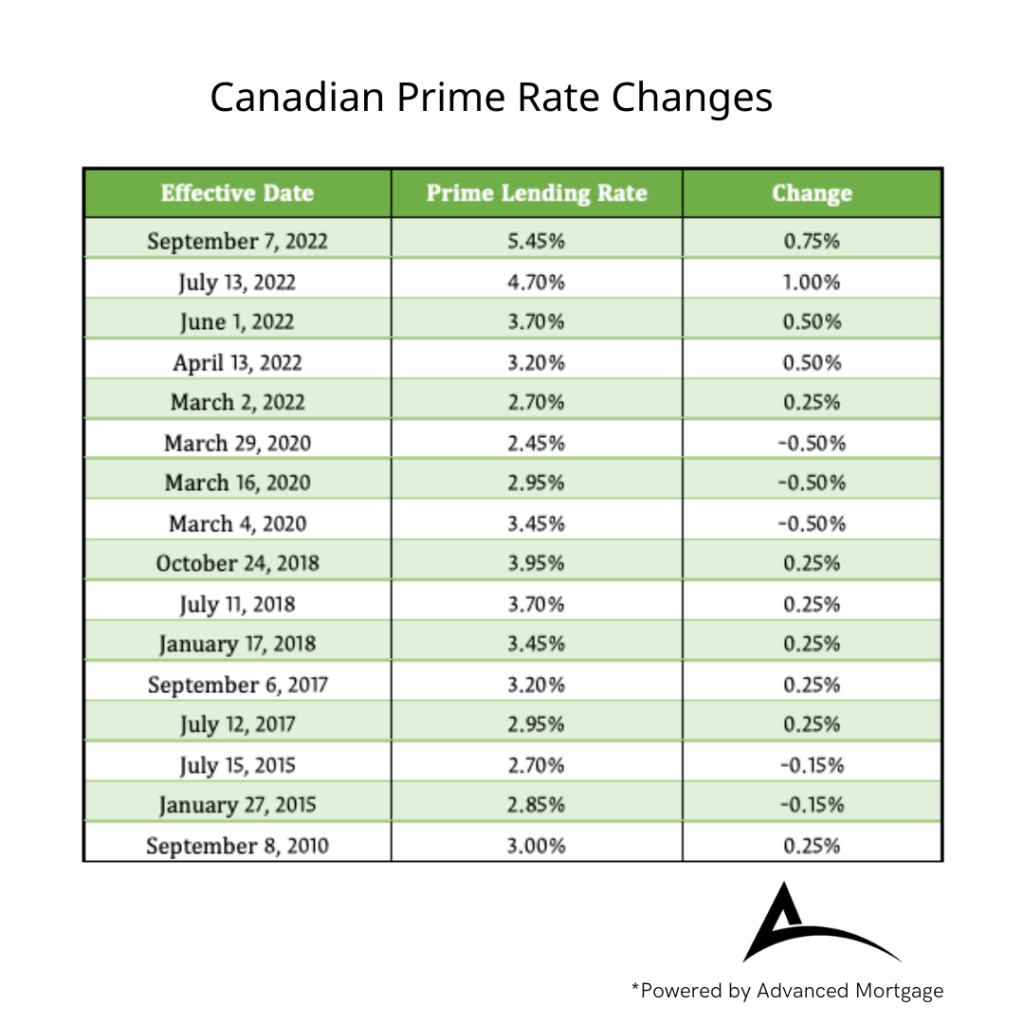
Anyone who isn’t living under a rock has heard about the rising interest rates lately. It’s a hot topic & most are anxiously wondering what the Bank of Canada might do next. Just last week they raised the overnight lending rate by another whopping 0.75%. We’re hoping they will now steady the ship and stay the course for the rest of the year.
*What ‘rates’ exactly are going up?
There are tons of different interest rates but the one we are talking about is the Bank of Canada’s (BoC) policy interest rate, also known as the target overnight or benchmark interest rate. This much talked about “interest rate” plays a key role in influencing many other interest rates. This rate represents the cost for banks to borrow money from bank to bank. This cost, in turn, leads to another key interest rate known as the bank’s prime rate.
The bank will use the prime rate to determine many interest rates for their lending, specifically this will affect variable-rate mortgages.The fixed mortgage rates are going up, too, however these are not connected directly to the BoC policy rate. They are influenced by the inflation rate.
*Why does the Bank of Canada raise rates?
The simple answer as to why the BoC raises its rates in the first place is to keep inflation low. The goal is to keep it at a rate of around 1% to 3% per year, as measured by the Consumer Price Index. The BoC is concerned with keeping inflation at bay and maintain a healthy economy. To do this, the most effective way is using their ability to set interest rates.
The BoC essentially controls the flow of money into the economy by controlling the amount of money that enters circulation. By increasing the interest rates, they can reduce the overall demand for money. People tend to spend less and save more when interest rates are high, which in turn reduces spending and helps to slow the rise of inflation.
The causes of inflation are complex, and many are international factors beyond the influence of the Bank of Canada. However, there are same domestic causes as well, Factors such as government benefits during the COVID-19 pandemic, rapid growth in house prices, and supply chain issues leading to low supply and increased commodity prices have worked together to grow inflation. Some may also point to corporate price gouging as a cause of inflation. While there has likely been some of this, it is not the only cause of inflation, nor the largest.
However, if the economy shifts too fast, spending may be so limited that businesses are forced to lay off their workers to cut costs. This period of mass layoffs and economic contraction is better known as a recession, and there is a real risk of such a scenario happening in Canada in the near future.
 Luckily for us, we are in good company when It comes to inflation. Though we can’t control international factors, central banks worldwide are also working to slow inflation in their respective countries, which should help the overall global economy.
*How far will these rate increases go?
Currently there has been estimates predicting rates to continue increasing at least until the end of the year. The BoC’s aim is to lower the inflation rate, so they will surely continue to raise rates until inflation is under control.
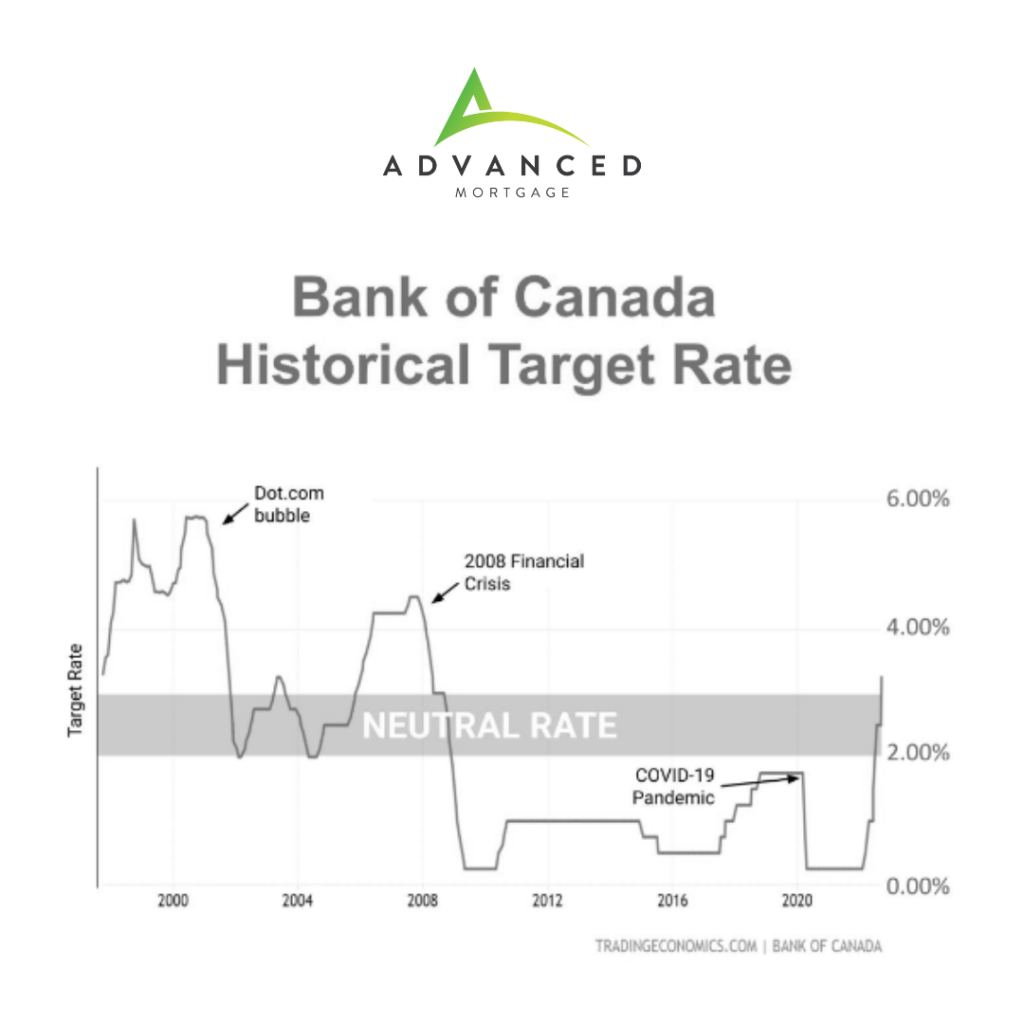
Current predictions put the BoC policy rate somewhere between 3% – 4% by the end of the year (currently we are at 3.25%). This would be in line with the interest rates seen in the 2000s, though notably higher than rates in the 2010s. Rates have been decreasing since the 1980s when the interest rate in Canada peaked above 20%. In fact, our current rates are more the norm than the exception.
*What does a rate increase mean to me?
The most obvious effect is rising mortgage rates. Especially for those who bought their homes in the last couple of years and opted for the very low variable-rate mortgages. Also considering factors such as an elevated market with higher purchase prices, this has resulted in paying higher interest on an even higher value loan.
Even though the BoC’s interest rate doesn’t directly affect fixed mortgage rates, it will put pressure on the bond yields that help determine these rates. As a result, there may be an increase in these rates as well when it’s time to renew.
As mortgage rates increase, home values may decrease as the affordability will be affected. Rate hikes may also affect home equity loans and some credit cards, among others. In general, this will discourage a lot of borrowing in the near future as debts become harder to service.
Businesses also will also be affected by an increased cost of borrowing. Not only will their costs go up, but the number of customers they have may decrease, This will encourage businesses to keep prices low. In the longterm, this works to reduce the inflation rate, which will hopefully be seen as a positive even if it comes after a few years of pain.
 In Conclusion
Ultimately, the bank of Canada is in a tough spot in the fight against inflation, What follows will likely be a period of increased costs for Canadian homeowners, reduced spending power, potential job losses and more.
As we all know, the economy works in a cycle, and despite the hardships these rising interest rates cause, it will benefit the Canadian economy in the long run. In the meantime, the best thing Canadians can do is educate & protect themselves, evaluate their financial situations and budget their spending so they can establish a foundation that doesn’t shake under the pressure. As an Advanced Mortgage Professional I can help with all of this! Give me a call today!
MY LENDERS